
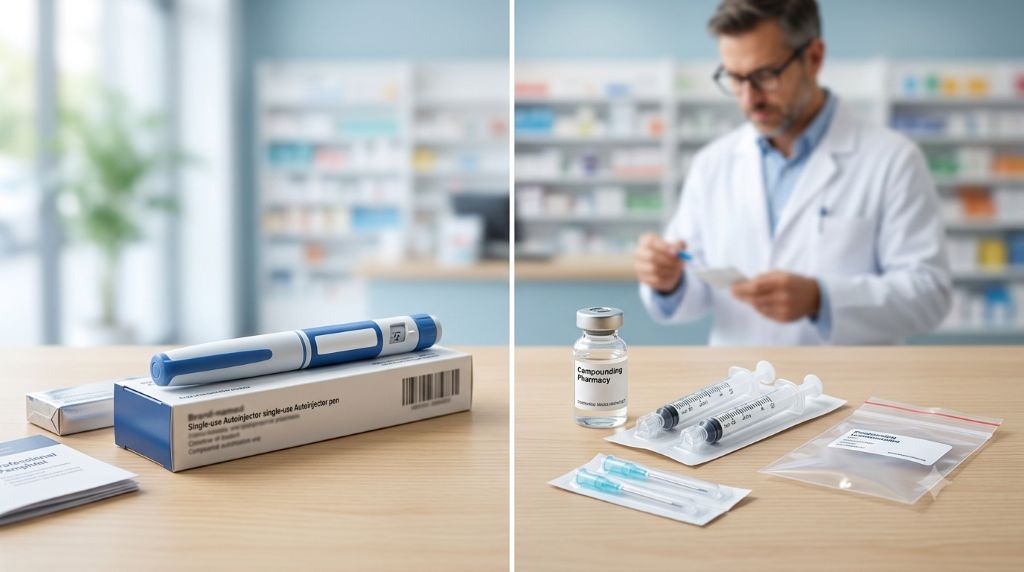
Semaglutide has quickly become one of the most discussed medications in weight management. But with its growing popularity, another question has become common: should someone use a brand-name product or a compounded version?
The answer is not as simple as comparing two prices or assuming that products containing semaglutide are identical.
There are important differences in FDA approval, formulation, manufacturing, dosing, packaging, clinical evidence, and regulatory oversight.
In this article, we will explore compounded vs. brand-name Semaglutide, what separates the two options, why dosing deserves special attention, and what patients should ask before starting treatment.
What is a Brand-Name Semaglutide?
Brand-name semaglutide generally refers to commercially manufactured products that have received FDA approval for specific uses.
Examples include:
- Wegovy
- Ozempic
- Rybelsus
These products go through the FDA drug approval process before they can be marketed for their approved indications.
The process evaluates factors such as:
- Safety
- Effectiveness
- Manufacturing quality
- Product consistency
- Appropriate labeling
Brand-name products also come with standardized prescribing information.
That information explains how the medication should be used and includes important details about:
- Dosage
- Warnings
- Contraindications
- Potential side effects
- Storage
- Administration
This standardization can make it easier for both patients and healthcare professionals to understand exactly what product is being used.
Interesting read: Understanding Semaglutide: Guide to Weight Loss & Health
What is Compounded Semaglutide?
Compounded medications are prepared by authorized compounding pharmacies when a commercially available medication may not meet a specific patient’s needs. Compounding is an established practice, but these medications have a different regulatory status from FDA-approved drugs.
- The FDA does not approve compounded medications through the same premarket process used for commercially manufactured drugs.
- Compounded products do not receive the same FDA review for safety, effectiveness, and quality before marketing.
- Compounded medications are not the same as generic medications. Generic drugs go through an FDA approval process and must meet specific requirements.
For people exploring medical weight management, whether they are working with a weight loss clinic in Dallas or another healthcare provider, it is important to understand what type of semaglutide they are being offered.
Understanding this distinction is important when comparing compounded vs. brand-name Semaglutide.
Compounded and Brand-Name Semaglutide: Key Differences
Understanding the difference between compounded and brand-name Semaglutide can help patients compare their options and make informed treatment decisions.
There are several areas to consider rather than one simple difference.
1. FDA Approval
- Brand-name semaglutide products such as Wegovy and Ozempic are FDA-approved for specific medical uses. They have gone through the FDA’s review process for their approved indications.
- Compounded semaglutide products do not have individual FDA approval. Instead, they are prepared by compounding pharmacies under a different regulatory framework.
The key difference is the level of FDA approval and regulatory oversight each product receives.
Interesting read: Weight Loss Medications: Saxenda, Ozempic, Wegovy, Mounjaro, Zepbound Explained
2. Formulation
- FDA-approved brand-name semaglutide products have standardized formulations and strengths based on the specific medication. Their dosing information is also established in the product labeling.
- Compounded semaglutide can have different concentrations or formulations depending on the prescription and the pharmacy preparing it.
Understanding the formulation is an important part of the compounded vs. brand-name Semaglutide comparison.
3. Packaging and Administration
- Brand-name semaglutide injections generally come in standardized packaging and delivery systems designed for the specific product.
- Compounded semaglutide may be supplied in a vial that requires the patient to measure the medication using a syringe.
The main difference is how the medication is packaged, measured, and administered.
4. Clinical Evidence
- FDA-approved brand-name semaglutide products have clinical evidence supporting their specific approved uses. This evidence is evaluated as part of the FDA approval process.
- A compounded semaglutide formulation should not automatically be assumed to have exactly the same clinical evidence as an FDA approved product simply because both contain semaglutide.
This is an important point when considering the compounded vs. brand-name Semaglutide options.
5. Dosing
- Brand-name semaglutide products have standardized dosing instructions based on the specific FDA-approved medication. The prescribed dose and administration instructions are clearly provided in the product labeling.
- With compounded semaglutide, the concentration may vary between products. As a result, the amount of liquid that needs to be measured with a syringe can also vary.
Always confirm the correct concentration and dose before using compounded semaglutide.
6. Cost
- Brand-name semaglutide can be more expensive, particularly for people whose insurance does not cover the medication or provides limited coverage.
- Compounded semaglutide may sometimes be offered at a lower price, depending on the pharmacy, prescription, and treatment arrangement.
Cost is one factor to consider when comparing compounded vs. brand-name Semaglutide, but it should not be the only one.
7. Availability
- Brand-name semaglutide products are manufactured and distributed as standardized prescription medications. Their availability can still vary depending on supply, location, and pharmacy stock.
- Compounded semaglutide availability may depend on the compounding pharmacy, the prescription, and applicable regulations.
Availability can vary for both options, so patients should discuss current access with their healthcare provider or pharmacy.
8. Regulatory Oversight
- FDA-approved brand-name semaglutide products are subject to requirements involving manufacturing, labeling, quality, and safety monitoring.
- Compounded semaglutide products operate under a different regulatory framework. The FDA does not review compounded medications through the same premarket approval process used for commercially manufactured prescription drugs.
The compounded vs. brand-name Semaglutide difference is especially important when it comes to regulatory oversight.
9. Pharmacy and Product Quality
- Brand-name semaglutide is manufactured by pharmaceutical companies using standardized production processes and quality controls established for the approved product.
- Compounded semaglutide is prepared by a compounding pharmacy according to a prescription and applicable requirements. The quality of the preparation depends on the pharmacy, its processes, and how the medication is handled.
Choosing a reputable pharmacy and following proper storage and handling instructions can help support medication quality.
What Side Effects Should Patients Know About?
Like other prescription medications, semaglutide can cause side effects.
Some commonly reported gastrointestinal effects include:
- Nausea
- Vomiting
- Diarrhea
- Constipation
- Abdominal discomfort
For some people, these symptoms may be more noticeable when treatment begins or when the dose changes.
However, serious complications are also possible.
FDA-approved semaglutide prescribing information includes warnings and precautions concerning conditions such as pancreatitis, gallbladder problems, and kidney problems associated with dehydration.
Contact your healthcare professional if:
- Symptoms are severe or persistent.
- You cannot keep fluids down.
- You experience abdominal pain.
- You believe you have taken too much medication.
- You experience an unusual reaction.
Never increase your dose simply because you want faster weight loss. More medication does not automatically mean better results.
Questions to Ask Before Starting Semaglutide
Before starting semaglutide, ask about the product, dosage, formulation, and follow-up care. Whether discussing weight management or visiting a TRT clinic in Dallas, understanding your treatment plan is important.
Ask about the medication
- Why is semaglutide right for me?
- Which product am I receiving?
- What is my starting dose?
- How should I take it?
For compounded semaglutide
- Which pharmacy prepares it?
- What is the concentration?
- How many milligrams should I take?
- How much liquid should I draw?
- How should it be stored?
Ask about follow-up
- When is my next appointment?
- What side effects should I expect?
- Which symptoms need medical attention?
- What should I do if I miss a dose?
Understanding these details can help you use semaglutide safely and confidently.
Interesting Read: GLP-1: How Semaglutide and Tirzepatide Help With Medical Weight Loss
Why Choose MyFitMed for Semaglutide Treatment?
Choosing the right provider is an important part of making informed decisions about semaglutide treatment. At MyFitMed, the focus is on personalized care, clear treatment guidance, and helping patients understand their available options.
Our approach includes:
- Personalized consultations based on your health history and treatment goals.
- Clear treatment guidance to help you understand semaglutide options.
- Individualized dosing plans based on your healthcare needs.
- Ongoing monitoring to track progress and address concerns.
- Patient education about dosing, side effects, and safe medication use.
- Compassionate support throughout your weight management journey.
Whether you are comparing compounded and brand-name semaglutide or exploring other weight management options, MyFitMed helps you make informed decisions with professional guidance and personalized care.
Conclusion
The choice between compounded and brand-name Semaglutide is not simply about finding the cheaper or more convenient option. The two can differ in FDA approval, formulation, dosing, packaging, clinical evidence, and regulatory oversight. Understanding these differences can help patients have a more informed conversation with their healthcare provider and avoid making a decision based only on price or availability.
There is no single option that is right for everyone. Your medical history, treatment goals, prescribed dose, access, and individual needs all matter. Before starting or changing Semaglutide treatment, talk with a qualified healthcare professional and make sure you understand exactly what you are taking, how much to use, and how it should be administered.
FAQs
1. Is compounded semaglutide FDA approved?
No. Compounded semaglutide products do not have the same FDA approval status as commercially manufactured FDA-approved semaglutide products.
2. Is compounded semaglutide the same as Wegovy?
Not automatically. Wegovy is an FDA-approved product with a standardized formulation. Compounded products are prepared under a different regulatory framework.
3. Why can compounded semaglutide dosing be confusing?
Compounded products may have different concentrations, and instructions can use milligrams, milliliters, or syringe units. Patients should confirm the exact dose with their healthcare provider or pharmacist.
4. Is brand-name semaglutide always the better choice?
There is no universal answer. The appropriate treatment depends on your medical circumstances, treatment goals, risks, availability, and guidance from your healthcare professional.
5. Can I change my semaglutide dose if I am not losing weight?
No. Do not change your dose without speaking with your healthcare professional. They can determine whether an adjustment or another treatment approach is appropriate.